
The cognitive offloading series · Part 1 of 3
A thoughtful version of the first question we get is: BrainScribe is AI — so isn't it just cognitive offloading? Letting a machine do the mental work your kid's brain should be doing.
It's a fair worry, and a real one. But "it's AI" hides the actual question. A spam filter is AI. A chess engine is AI. Whether something is cognitive offloading — whether it takes over the thinking — depends on what it actually does. So the honest question is sharper: what would cognitive offloading actually be, in writing?
To answer that, you have to notice that "writing" isn't one thing.
Writing is six steps, not one
When we tell a kid to "go write," we're really asking them to do six things in a row:
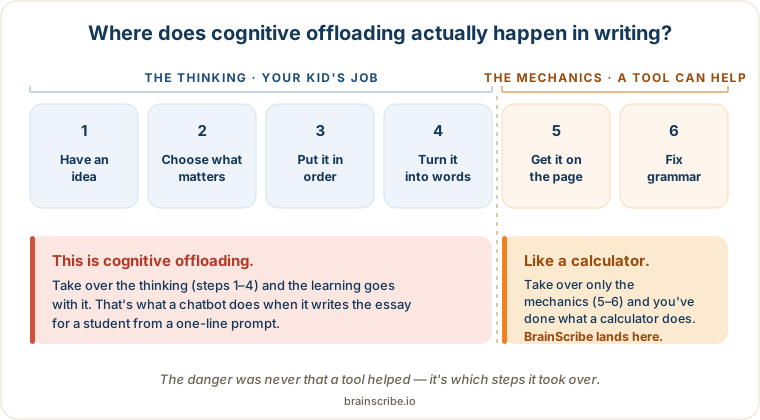
The first four steps are the thinking. The last two are the mechanics. And for a lot of kids — especially those with ADHD or dysgraphia — steps 5 and 6 are exactly where everything jams. They have plenty to say. Getting it onto the page is the wall.
So what counts as cognitive offloading, really?
Cognitive offloading in writing is handing over the thinking — steps 1 through 4. That's the part the research actually worries about, and it's exactly what happens when a kid asks a chatbot to write the essay: the machine has the idea, decides what matters, structures it, and words it. The student did none of the part that makes them a writer.
Steps 5 and 6 are different. Getting words onto a page and fixing commas isn't the cognition an essay is meant to build — it's the mechanical wrapper around it.
The calculator already settled this
Nobody worries that a calculator makes kids worse at math. Not because arithmetic doesn't matter — but because in algebra class, arithmetic isn't the learning target. We hand off the mechanical part on purpose, so the kid's attention goes to the actual thinking.
Same logic here. For a middle-schooler's essay, the learning target is the argument — not handwriting speed or spelling. Clear the mechanical jam and the effort flows to the part that counts.
Where BrainScribe lands
Only on steps 5 and 6. The student talks; BrainScribe asks questions and helps get their own words down and tidied. Steps 1 through 4 — the thinking — stay entirely theirs.
Here's the line that matters, and it's built into how the product works: BrainScribe can only ever organize what the student produced — it can't supply the thinking. Take away the kid's answers and there's nothing left; the coach has no essay of its own. That's the whole difference between a tool that organizes your thinking and one that supplies it. One is a calculator. One is a ghostwriter.
I'll be straight about the one real caveat: tidying "um, like, when his friend moves away" into a clean sentence involves a little phrasing. It's bounded — it strips filler and fixes mechanics, it doesn't add ideas the kid didn't say — and you can see exactly what changed, because the before-and-after is right there in the transcript.
You don't have to take my word for it
That's the part no other tool offers. Every BrainScribe session is a transcript you can read — the questions, and your kid's own answers, start to finish. If you ever suspect it did too much of the thinking, go look. Steps 1 through 4 will be sitting right there, in your kid's words.
The danger was never that a tool helped. It's which steps it took over. BrainScribe takes the mechanical ones — the wall that stops so many kids before they start — and leaves the thinking exactly where it belongs.
Request an invite — BrainScribe is invite-only while we're in early access.
The cognitive offloading series
1. A calculator for writing — but not for the thinking (you're here)
2. Why chatbots cause cognitive offloading
3. How coaching avoids cognitive offloading